

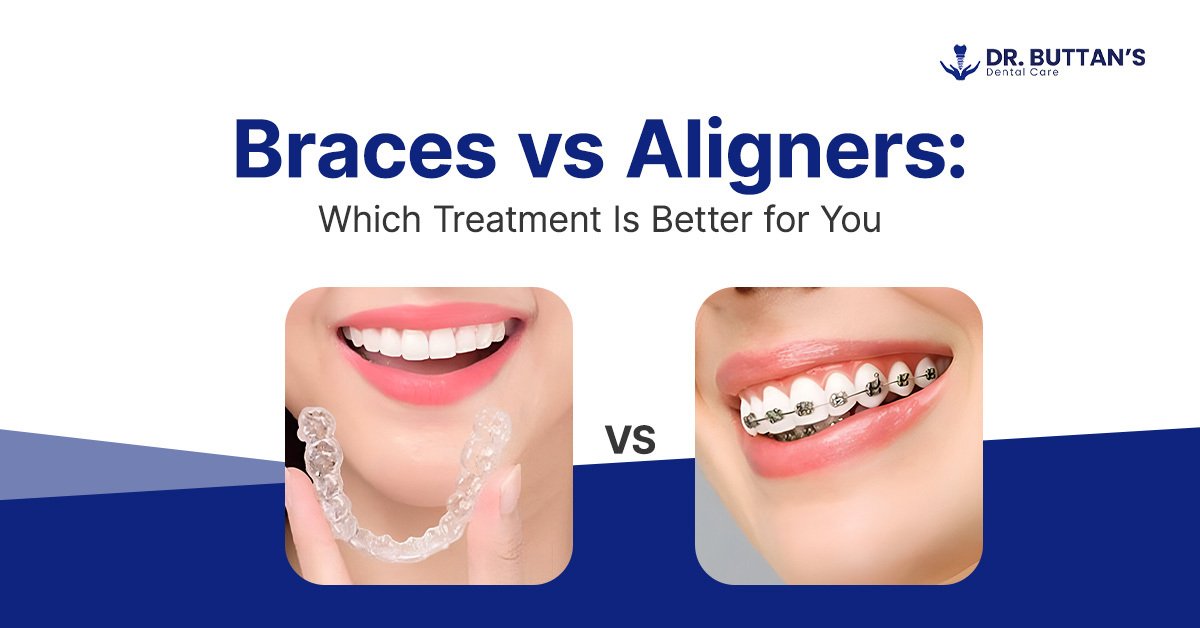
Both braces and clear aligners will straighten your smile in 2026; it will be a matter of your biting complexity, your lifestyle, and discipline that will determine which of these will be the best. This guide contrasts their mechanisms, efficiency, prices, and the impact they make on a daily basis to help you make up your mind.
Braces vs. Aligners: Table of Contents
- Introduction
- How They Work
- Key Differences
- Effectiveness & Cases
- Treatment Time
- Cost & Maintenance
- Lifestyle Fit
- Pros & Cons
- How to Choose
Braces and clear aligners will equally be strong end-of-the-mainstream remedies against straightening teeth in 2026, yet the superiority of the two relies on the complexity of your bite, your lifestyle, and your budget, as well as your discipline levels regarding treatment in Dr. Buttan’s dental care. This guide takes you through all that you should know to ensure that you can make a decision on the kind of orthodontic treatment that fits you and not what looks good on Instagram.
What Are Braces and Aligners?
- The fixed orthodontics called braces are brackets attached to the teeth, attached by a wire that slowly moves the teeth into place over a period of time, by one of the best dentists in Rajouri Garden. New types of braces may be made of metal, tooth-colored ceramic, or even placed on the back of the tongue or the teeth (lingual), although they function in the same way by exerting constant pressure by altering the wires.
How Every Alternative Moves Your Teeth:
- Different wire shapes, sizes, and materials, as well as elastics, springs, and other add-ons, enable the orthodontist to manipulate the movement of teeth in three dimensions with the help of braces in the best dental care in New Delhi. You never need to worry about braces since they are fixed and hence are working at all times, as long as they are on your teeth, no matter what you do with them.
Bracelets vs. Braces in 2026: Is it still more effective?
- Most recent research, however, has shown that both braces and clear aligners can be used to address mild to moderate crookedness, gaps, and bite problems with a high level of success, assuming that patients adhere to the instructions. Better planning and the ability of your orthodontist will do you better than the brand name.
- In very complicated cases—extreme crowding, huge overbites or underbites, turned-around teeth, impaction of teeth, and issues with the jaw, which require very complex mechanisms—braces are still likely to do a better job than aligners.
- In the case of Stronger Aligners (or at least as equal)
When used in clear-cut situations, the aligners include:
- Moving to mild and moderate crowding or spacing.
- Minor overbites or crossbites.
- Patients have relapsed from earlier orthodontic therapy.
- Firstly, cosmetic adult straightening.
Aligners are capable of producing the same result as braces in such cases and may even end up quicker since therapy is thoroughly pre-planned and simpler to track in well-behaved patients.
Complexity of a Case: Simple or Complex Bite?
- It is good to know where you stand on the complexity spectrum before you give a thought about brands.
You happen to be more of a good aligner-only candidate when:
- Crowding/spacing is light or medium (not teeth upon each other).
- Bones of the jaw are largely in normal relationships (there is neither excessive growth nor shrinkage).
- You have not been told that you have to have your jaw operated on or wear very heavy elastics.
- You are not even trying to repair a big bite, but have straight teeth and a nicer smile.
You have more chances to require braces (or at least some hybrid plan) in case:
- Your frontal teeth overlap with each other strongly, or they do not intersect (deep bite or open bite).
- It is either that your lower teeth are pretty far forward of or are way behind the upper teeth (a bit of underbite or overbite).
- There are also several teeth that are tilted 45 degrees or worse off, badly tilted, or affected.
- You have a history of jaw problems, and this might necessitate the use of complicated mechanics or surgery.
Treatment Time: What Will It Be Like in 2026?
To illustrate simple instances, the mean time of treatment of braces and aligners is not as different as it may seem:
Mild-moderate cases
– Braces: It is approximately 12-24 months.
– Aligners: The period may be 6-18 months or even comparable to braces or a little less.
Complex cases
– Braces: they may be more efficient and predictable, although overall, it may take 18-30 months.
– Aligners: may require the same or more time, depending on whether you need the so-called refinement series or whether you have issues with wear time.
Self-concept and Everyday Life.
- This is one of the aspects in which most patients experience the greatest change.
Braces—what is it like to live every day?
- It is normal to experience some soreness in a few days following every type of adjustment, as well as the aggravation of the parts of the body where the brackets scratch the cheeks and lips.
- Foods that can disintegrate brackets (hard, sticky, or chewy) are prohibited (especially when they are fresh).
- Brushing and flossing are time-consuming, and one can easily trap food, which increases the chances of decay and gum swelling.
- Versioners—how everyday life is.
Mild soreness and pressure may occur when the tray is used; however, there tends to be less rubbing, and the mouth ulcers are less frequent.
- Oral care is a lot simpler: brush, floss, and pop trays back in. Trays themselves have to be washed, but once it becomes an everyday thing, it is not that difficult.
Aesthetics and Confidence
This is the make-or-buy factor for several adults.
- The braces, particularly metal, can be easily spotted both in the real world and in the photos, whereas the ceramic or tooth-colored brackets are less obvious.
- The clear aligners are usually invisible to a point that is conversationally distant, especially on video or in photographs, and thus are widely accepted among people in fields where they handle customers, jobs that are creating the content, and even within the content creation sector.
Comparison of Braces and Aligners: Cost and Value.
The prices in different countries, cities, and clinics are extreme, yet the following general tendencies are common in most markets:
- Conventional metal braces are usually placed at lower and middle levels of orthodontic costs.
- The price of braces made of ceramics is a little higher because of the materials and appearance.
- Clear aligner systems with a brand can be equally expensive as braces or even more so, especially when treating a full mouth.
- Unsupervised aligners, sometimes termed “mail-order,” are also less expensive but have serious clinical risks and cannot be compared with supervised orthodontic treatment.
When comparing, look at:
- Whether the fee covers all the visits, emergencies, refinements, and retainers.
- Extra or more aligner sets and extra months in braces are costly or not.
- Comparison between the costs of lost/broken aligners and broken brackets and emergency visits.
Oral Health, Maintenance, and Hygiene.
With braces
- To clean around brackets and wires, you will have to use orthodontic brushes, floss threaders, or water flossers.
- It is more difficult to control the plaque; the white spots and cavities may occur around the brackets in case brushing is not done regularly.
- Broken bracket repair appointments or poking wire appointments may be an unwanted inconvenience.
With aligners
- It is almost like brushing and flossing your teeth as normal.
- Aligners need to be washed every day as well (not with hot water, which may damage them).
- Stuffing between meals with snacks or drinking sweet beverages with trays can trap sugar and acid on the teeth, which is equally harmful to the health of bad habits on braces.
Compliance and Personality Fit.
It is probably the least appreciated element of your own behavior style.
Aligners are more appropriate for you, provided you:
- Punishing (gym, diet, work, etc.).
- Hardly ever lose objects such as keys or glasses.
- There is nothing wrong with saying no to another snack as long as it involves removing and cleaning trays once again.
- Are very aesthetic and convenience-oriented.
You would be a better candidate for braces when:
- Tend to forget about retainers, mouthguards, or other removable materials.
- Eat all through the day or drink coffee/tea all the time.
- Realize that the idea of wearing it 22 hours a day will not be something that lasts.
- Like having a background working solution to an installed program.
Specific case studies are to be taken into consideration.
Teenagers
- Most people prefer using braces with teenagers who might not be ready to adhere to the rigidity of using the aligners, particularly when their bites are still forming or complicated. It has become possible to have built-in wear indicators and teen-friendly features in some aligner systems, but the burden is still on the shoulders.
Busy adults in their careers.
- Aligners are popular among adult consumers who are concerned with their looks, make presentations, or need to be seen on camera. To them, the ability to discreetly straighten teeth and take trays off whenever a crucial event comes might justify the additional expense or effort.
Athletes and musicians
- Athletes of contact sports are inclined to use aligners, as this type of device can be removed and replaced with a custom mouthguard, although braces can be combined with special mouthguards. Aligners can allow wind-instrument musicians to be comfortable during play when compared to brackets in the lips.
- Surgery or very complicated corrections are required by patients.
In these cases, there is still a tendency to favor braces, with the subsequent use of aligners at a later stage to polish them or during the post-surgery stages.
How to choose what is better for YOU in 2026.
The following three-step outline can be used prior to committing:
Clinical reality check
Make an appointment with an orthodontist (not an online aligner brand or a cosmetic dentist).
Ask clearly:
– Is my case mild, moderate, or complex?
– Could braces and aligners produce as predictable results as they did for me?
– Could I handle this case with aligners on my own, or would you change me to braces in case of necessity?
When the response is “Your case is complicated; I would greatly prefer braces,” then listen to that response, even though you are determined to use aligners.
- Audit of lifestyle and personality.
- Be mercilessly frank with oneself:
- Will you really wear trays 20-22 hours a day for one year or more?
- Do you accept the idea of putting off aligners and brushing after each snack or colored drink?
- Or would you take visible braces but not always think of wear time?
Select the system to which you are most apt to adhere, and not the one only that you prefer to see.
Long-term and short-term perspectives.
- Compares full and written quotes of the two options, including check-ups, refinements, and retainers.
- Compensate against the chance of aligner loss and the flexibility of appointments.
- Don’t just think about straight teeth: which would provide the most likely opportunity to have a healthy, stable bite, clean teeth, and a lasting result?
And, therefore, the braces vs. the aligners: which is the best in 2026?
- Braces will be the most flexible, powerful solution to complex orthodontic issues, and the patient needs an orthodontic solution that they can set up and leave alone without relying on an everyday reminder of their own determination. Nonetheless, clear aligners can be preferable in most cases with adults and responsible teens with slight to moderate problems who are concerned with appearance, comfort, and flexibility, and can be disciplined.
- The most intelligent thing that comes next is to then apply this knowledge at your consultation with an orthodontist by asking them more refined questions and then selecting the alternative that best suits not only your biology but also your behavior. It is that combination, not the marketing, that will provide you with your best smile in 2026 and beyond.